Have you watched Midnight Diner? It’s a feel-good, feel-melancholic series about a “master” who runs a small, nondescript diner tucked away in a back alley of Tokyo. The diner has a very limited menu, primarily featuring a single dish – pork miso soup with rice, but Master is willing to prepare any dish requested, as long as he has the ingredients. Each or every other episode focuses on a specific patron or group of patrons, who share their life stories. I stopped watching it mid-episode of some season because I save “good stuff” to watch later.
The following is a story I randomly wrote one day from the top of my head, imagining I was one of these patrons at the Midnight Diner. Lol. You don’t have to have watched Midnight Diner to read this story.
A man in a black raincoat walks in. He is quiet, unassuming, and sits down in the farthest corner of the diner. He orders the usual, but the Master doesn’t follow what he says, so he asks him to repeat it. The man replies, ‘The u-su-al.’ Each syllable pronounced with deliberate clarity – every slight pause between the syllables a calculated attempt to avoid having to repeat himself again. One look at him, and you know he probably isn’t the chattiest person you’ll ever come across.
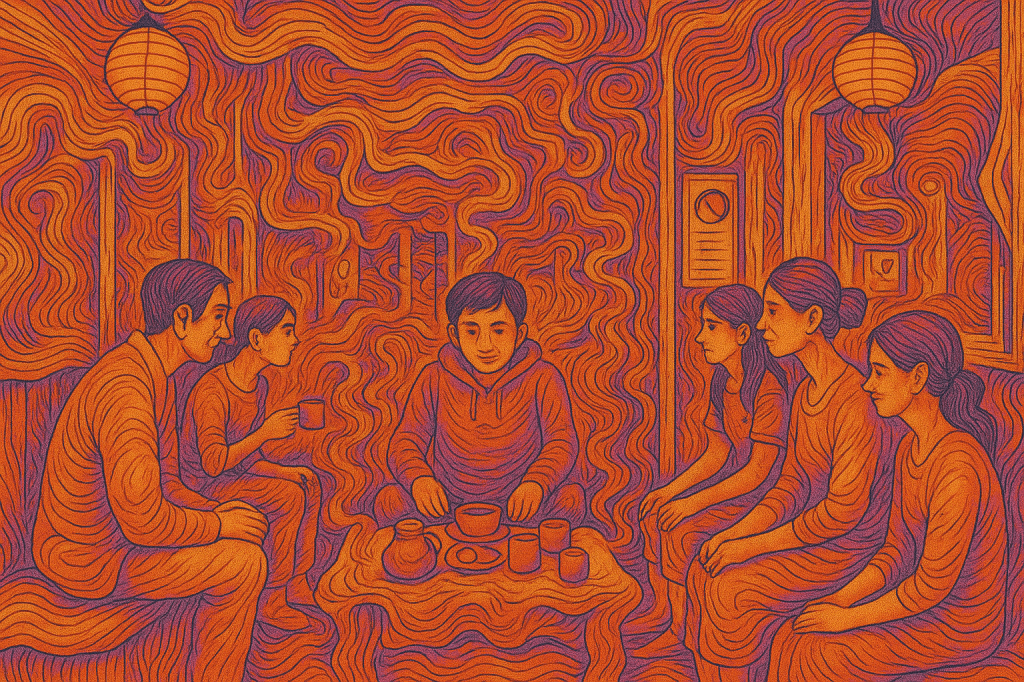
The most animated presence in the room today, however, is a 10-year-old child who has been obsessed with how his history project ranked first in his class today. His questioning hops from one person to the next around the circle, asking if any of them ever had a history project they remember, when his eyes finally locate the quiet man in the corner, and he is asked the same. He gently shakes his head and carries on slurping his miso pork soup. The child keeps staring at him. And just like that, all eyes shift to the quiet man – the very outcome he had hoped to avoid.
Usual pleasantries are exchanged, usual questions are asked about what he does, where he works, and where he lives. He seems stand-offish but you can’t exactly say he’s rude. He’s quiet but you can’t exactly say he doesn’t know what to say. There’s an old woman in the crowd, and old women have this uncanny talent for coaxing secrets out of people. They ask the kind of questions that would get anyone else a polite smile and a quick exit, but somehow, with them, you just… answer.
He is asked what is on his mind a few too many times, he shakes his head every time. At one point, the child teases him, saying, “Probably his girlfriend.” He brushes it off. But the old woman – old women, I tell you. She keeps egging him on. He gently lays his hand on the old woman’s shoulder, makes gentle eye contact, and shakes his head again. The old lady does not push him to say anything anymore.
A group of teenagers comes inside and takes an odd amount of time to take off their coats. One of them almost topples over, followed by a pin-drop silence in the room. Then comes a low rumble of thunder from outside. Instinctively, everyone turns to the window. The quiet man looks up, and just like that finds the entire room looking at him again. It’s likely because he is seated directly in front of the only window in the small, dimly lit room. The window draws attention first, and with it, so does the one figure outlined against its pale light.
He feels a flicker of annoyance, likely because all he wanted was to eat quietly by himself, not become the center of attention in a room full of strangers expecting him to engage. He exhales sharply through his nose and, resigned, begins to speak. He says he doesn’t have a girlfriend. That nothing’s on his mind and yet, so much is. He reveals that he’s schizophrenic, and admits he’s not even sure if everyone he’s talking to right now is real.
An awkward silence follows. A few people wonder if Shisheng’s joking. Oh, by the way, the quite man’s name is Shisheng.
Shisheng continues, says he grew up a geek – braces on his teeth, thick black frames perched on his nose, shoelaces always untied, and a stubborn layer of grime peeking where his collar gaped open. Kids have a habit of targeting the quiet ones, and Shisheng was no exception. Shisheng says his schizophrenia is a result of has trauma-induced psychosis.
He did not have many friends growing up but one girl, when he was 12 years old, seemed to take pity on him and became friends with him. “Friends,” as in: she helped him with algebra, then said “bye” when school ended. You give a beggar a scrap of food and he will consider the scrap of food worth 10 meals. You give Shisheng a “bye” from Yui, and he will build sandcastles in the air. During days, he could see her at school, during night, if he was lucky, he could see her through the house next door. Yui was also his neighbor.
One day, after returning from class, he walked into his house to find his mother hanging from the ceiling fan. Shisheng stood frozen in shock; his hands slowly loosening their grip on the bag straps. Step by step, he retreated – reversing the very path he’d taken to enter, as if trying to erase his presence from the house entirely.
He took the backyard route to his neighbor’s house and unexpectedly came upon Yui, deep in conversation with a group of friends – just as they were talking about him. Shisheng heard them mocking, and throwing out snide remarks. Kids could be brutal about him but that was nothing new to him, he was used to that. What he wasn’t used to was Yui joining in with other. She laughed, then called him a loser. An idiot. A slob. And a few other names Shisheng can’t remember anymore. But he remembers how something sank in his stomach, and how a dull ache spread across his chest. The sandcastles he’d built in his mind seemed to come crumbling down.
From a distant corner of the backyard, he stepped into view. Yui saw him. Her face flushed with embarrassment in front of her friends. “Please go,” she said flatly. Her friends laughed.
It would’ve been easy to assume that Shisheng’s trauma-induced psychosis stemmed from his mother’s suicide. So naturally, one might think it was her who haunted his hallucinations. A ghostly figure wearing the same clothes she had on when he found her hanging – her neck bent at an unnatural angle, the rope marks still etched into her skin. Maybe you’d picture her lying motionless on the ground at first – until, slowly, her head turns to follow Shisheng with her eyes. Watching him. Wherever he goes. Whatever he does.
But it’s not his mother he hallucinates.
It’s Yui.
Sometimes, it’s not the core traumatic event that stays with us, but the quieter moments surrounding it – the ones that bruise us in ways we struggle to name, yet never quite forget.
For the past 15 years, Yui has appeared to him in fits and starts – sometimes every day for a week, other times just once a month. But always, she looks the same: standing there in the green frock she wore that day in her backyard, eyes fixed on him with an expression he still can’t quite read. She never speaks. She only watches. And her face always carries that same flush of shame from the day she saw him there.
Each time he hallucinates Yui, he chants her words back to her: “Please leave.” As if saying them might somehow might even the score.
Sometimes, he tried to imagine what she would look like now. And once, just once, his mind ran too far. He was heading out, opened the door, and saw her standing in the hallway. Not as the 12-year-old he remembered, but grown. Older. Real. As always, he told her to leave. This time, she reached out to touch him. He brushed her off, shut the door, and bolted it tight.
The diner is quiet. There’s a heaviness in the air. Not wanting to draw pity, he quietly sets his chopsticks down on his empty plate, rises to his feet, and offers a small, respectful bow in thanks for the meal and the company. Before leaving, he takes a moment to shake hands with each of us – even me.
As he reaches for my hand, his eyes catch the bracelet on my wrist – a unique macrame design. He pauses, surprised. He’s never seen one quite like it before. He asks where I got it. I tell him my roommate made it for me. I extend my hand again, and that’s when something shifts. His eyes widen. His pupils dilate. A bead of sweat hits the floor. It hits him – suddenly, vividly. The grown-up version of the girl he once hallucinated was wearing a bracelet just like mine. He hadn’t thought much of it then, but now, staring at it, he realizes he’d never seen a macrame bracelet before that moment. He is thrown off balance. For a brief, dizzying moment, he wonders: Did Yui actually come looking for him?
It feels like forever has passed between the moment I offered my hand and the storm of thoughts that ran through his mind. But he doesn’t say anything. Instead, he shakes my hand calmly, thanks me, and continues on shaking hands with the rest.
We all walk him out. The master stays behind, of course, but six of us walk out with him. It wasn’t far, just a short distance until we reached the front of his apartment. He thanked us once more, wished us well, and we parted ways.
As we walked away, someone glances back and sees him entering his apartment. His silhouette moves slowly, he checks his mailbox and begins sorting through the mail – calm, focused, as if nothing unusual had happened. The possibility that his “best friend” had come to see him after all these years seemed to register no reaction. No pause. No glance back. No flicker of doubt or recognition. Just a quiet, practiced acceptance – like someone who had long since learned that some things are easier to carry than to confront.
 Between The Squiggles
Leave a comment