You know how you can remember the house you grew up in down to the smallest details? Yeah. It happens because we love that house, and that house lives inside us. But did you also know that just as a house can live within us long after we’ve left it, we, too, live inside a house long after we’ve gone?
It sounds all too complicated when said like this but easier when explained in a different way. For example, consider us (human beings), not houses. We carry pieces of everyone we’ve known inside us, our parents, our friends, even strangers, and these pieces show up in the way we walk and talk, or even in the smallest habits we don’t notice we picked up. Houses are the same way.
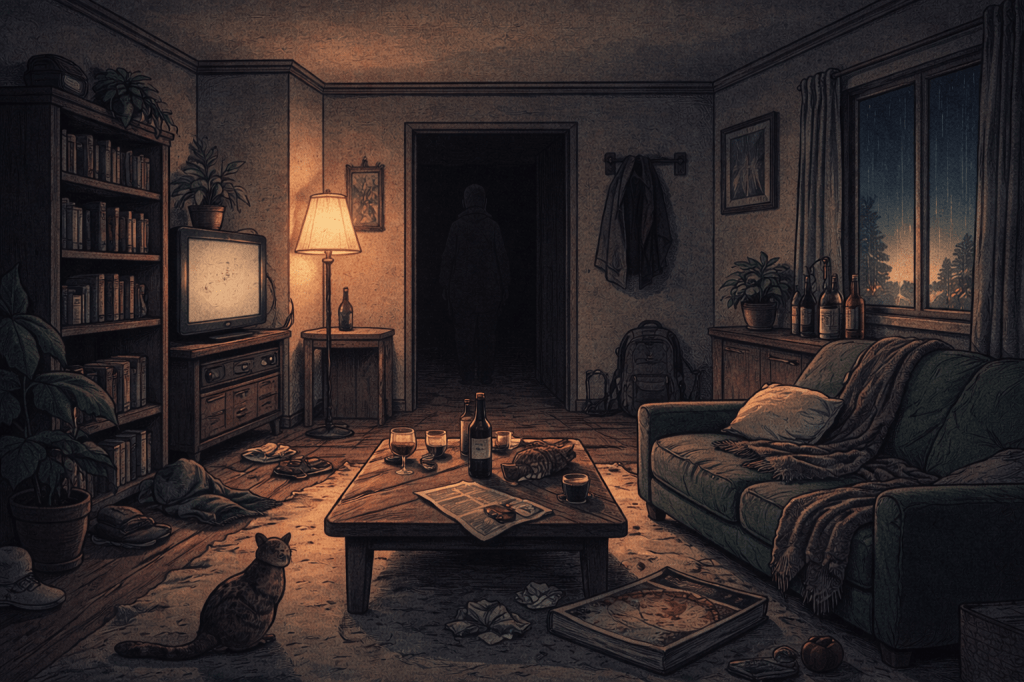
But houses don’t have mouths to speak or limbs to move to communicate with us. However, they’ve spent years watching people live inside them—seeing doors opened in a hurry, foot water taps left running, chairs pushed back, and the dining table put back into place. All of that settles into the house like memory. And it uses that memory as a kind of language to talk to us. That’s why when we feel as if someone has turned the doorknob (when nobody has), or when we hear faint footsteps on the staircase (even though nobody’s home)—it’s the house talking to us in the only language it knows. To, perhaps, say to us that we are not as lonely, after all.
You know what else I think? I think just how we have our favourite people, it is possible that houses have their favourite people too. That could be why the same house behaves differently with different people—a floor that stays steady under one person’s feet but seems to slip under another’s, or a door that refuses to open for someone while another reaches for their keys and finds it already ajar. And perhaps this is also why, when something goes missing in a house and nobody in the family can find it anywhere, and it somehow appears again weeks, months, or even years later — out of the blue, tucked between the cushions of the sofa or hidden in the quiet nook of a shelf. We usually blame our own carelessness, or assume that we must not have searched properly the first time. But maybe the truth is a little stranger. Maybe it was the house’s way of playing hide-and-seek—hiding the thing from everyone else until the one it liked most came looking.
After we leave a house, it does not forget the love it once held for us so easily. Perhaps that is why, when newer tenants come in, they must paint over the tainted walls, fix the worn-out door sills, and install new taps, trying gently—or sometimes forcefully—to wipe away the traces the previous tenants left behind, traces the house itself seems reluctant to surrender. But a house knows how to love again, even if it does so with a little resentment at first. And so it welcomes the new family with open arms, waiting patiently on its pillars to learn the new language the new family has brought with it, while somewhere, quietly, the echoes of those who lived there before continue to linger within its walls.
 Between The Squiggles
Leave a comment